суббота, 16 апреля 2016 г.

At the edge of the Old World (2.11.15)

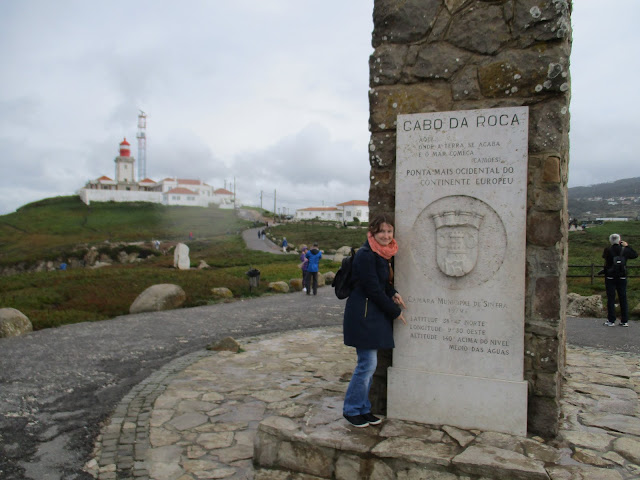
Long ago, the Romans called that spot Promontorium Magnum ("the Great Promontory"). Many centuries after, the greatest Portugal's poet Luís de Camões referred to it as to the place, "where the land ends and the sea begins" in his epic work "The Lusiads". Just 80 years before the most famous work of Luís de Camões was published, nobody in that part of Europe knew that the land to the west of Cape Roca exists. 523 years after Christopher Columbus had discovered the New World, we stood in a few meters from the waters of Atlantic Ocean, at the westernmost point of continental Europe, and enjoyed the breathtaking views.
Even though the weather was terrible, lots of tourists crowded the cape. Just imagine, how popular that place would be before the Age of Discovery, if tourist industry existed at that time. I mean, you will more likely come to the edge of the world rather than just to the extreme point of Europe :)

We observed a curious fact regarding tourists. In contrast to most of the sights we had visited, where West European (especially, French-speaking) visitors predominated, here Russians and Chinese prevailed. I guess my nation and our south-eastern neighbors just appreciate achievements (such as visiting the particular spot) more. If not, why would people stand in a queue to have their photos beside the monument noteworthy only for a plaque proving that you are at the westernmost corner of Europe.
We also recorded our "achievement".
Most of the tourists just capture themselves on film and come back to the bus. Some of them buy a certificate of their presence at the Cape (is it for their incredulous friends who don't believe in photos and claim that "it is photoshop"? :) ). As usual, almost nobody turns out to be inquisitive, almost nobody notices the splendor of the surroundings.

If you don't want to be that kind of tourist, first thing to do everywhere is to look around.
 
After you have got to know how the land lies, start exploring it down to the smallest detail. Follow us and stroll along the shore.
In the place most tourists content themselves with, the stone wall separates us from coming closer to the ocean. Then it changes into a wooden fence which doesn't look solid enough to lean against. If you continue going along the fence, soon it will be over as well. No safety barriers, no supervisors. It looked really strange. Believe me, we haven't crossed any "do not go further, it is dangerous" lines. Still, if you are not careful, it can be. If you are wary enough, you'll be rewarded with the most picturesque sceneries Cape Roca provides immediately below your feet.
Look above, five minutes ago we were where those tiny creatures stand.

Even though we haven't seen other people daring to descend from that cliff, we definitely were not pioneers. Here is the proof.
If you don't know, it's an imitation of the Saint Petersburg football club emblem

It's funny to remark that I noticed that inscription only when I was reviewing the photos after coming back to Saint Petersburg. I'm still curious whether my poor eyesight or the greatness of the ocean distracting me from spotting the details was the reason.

You can reach Cabo da Roca from Lisbon in two ways: through Sintra or through Cascais. Since we'd visited Sintra two days earlier, we chose the latter option. My first memory of that morning is the bus from Cascais approaching the Cape via a serpentine road. This road is so long that you start thinking that the ocean doesn't want you to come.

On the way back to Lisbon we decided to spent some time exploring Cascais. You won't find any striking places of interest there but overall the town is a pleasant place.

Even the shopping center is worth looking at.
 
But the weather is getting a bit better, let's go outside. To understand how small is the town, look at its center:
In summer Cascais attracts the visitors by its sandy beaches and a large yacht harbor. Although we came there on a rainy day in November, we headed to the water. Obviously, most local landmarks should be where crowds of tourists usually are.  
Look to the left: the "fleet" is approaching! :)
And this one resides on the shore.
Have you ever seen giant binoculars?
And how about red trees?
The below photo wasn't noteworthy until my parents joked telling me that they see... hedgehogs amidst pineapples on it. 
Street art in Cascais is no less amazing than it is in Lisbon.
Need some action? Just imagine that this speedy bird on the photo below is running back and forth, escaping from the waves and presumably looking for the seafood brought by water at the moment when the waves receded.
As a conclusion of a story about Cascais, a minute of local humor:

The final pieces of the travel diary came up into place. Thank you for staying tuned for the last 11 posts! New stories on miscellaneous topics will come soon ;)

суббота, 9 апреля 2016 г.

Expo '98, misleading names and foreign languages. Lisbon, 31.11.15-4.11.15

During our last day in Lisbon we explored it in a different fashion: rather than walking in the historical center, we visited more modern parts of the city. From Estufa Fria and Gulbenkian Museum, which both lie to the north-west of the historical center, we headed towards the eastern corner of the city, to the Park of the Nations.

Here everything contrasted with what we'd seen before.
 
It is no surprise because in 1998 this part of Lisbon greeted millions of visitors who came here to attend the Lisbon World Exposition. The Expo '98 commemorated 500 years of Portuguese discoveries. Half of a millenium before, in 1498, Vasco da Gama arrived in India. Nowadays two colossal сonstructions, named after the great voyager and situated in that part of Lisbon, remind us of him. They are the longest bridge in Europe extended for over 17 kilometers
and the tower, currently serving as a hotel.
The tower is joined to Oceanarium by a cable car system.
I was less impressed by Lisbon large-scale public aquarium than by the one in Saint Petersburg which I visited about 8 years before. However, Portuguese house of aquatic animals has its appealing features. You can see not only an aquarium there but also the reconstructions of penguins, sea-otters and other non-fish marine animals habitats. 
Turning back to the first association with the word "oceanarium", here is the potpourri of what attracted me the most:
Masters of disguise

Winning hide-and-seek versus an octopus
Jellyfish, adds lighting to your photos for free
Potpourri of fish inside the potpourri of photos
Sea corridor

The only large creature finning slow enough to take a picture of it

Probably, there could be more pictures but speedy sea animals were not the only problem for the quality of photos. Taking a picture becomes challenging when there isn't enough light, and, unfortunately, jellyfish don't inhabit each part of the large aquarium to make the photos brighter.
   
The last memory from that place, which I'd like to share with you, refers to a penguin. Unlike those which stand motionless on one of the above photos, that one was floating along a closed path in the aquarium among other sea inhabitants incredibly fast, faster than any other creature in Lisbon Oceanarium. I knew that penguins are skilful swimmers, but never though that they are so cool!

Let's leave the oceanarium and come back to fresh air. It's worth noting that outside it's warmer than inside the building (it's November!). Strolling through the Park of the Nations you can encounter lots of funny objects: like these "chanterelles", 
that volcano fountain (see wiki to understand why it reminds a volcano when works at full power),
and these thematic benches.

Let's transport ourselves from the Park of the Nations to the place concluding the list of sights we planned to visit in the capital of Portugal. This is Museu Nacional de Arte Antiga, or the National Museum of Ancient Art. If you refer to the Wikipedia article about it, you'll read that the English translation of the name of the museum is misleading in that the collection includes no museologically "ancient" works of art, but rather holdings that are simply old or "antique." We didn't know that beforehand, and hence were surprised that the oldest displays here belonged to the Middle Ages and the most modern ones pertained even to the XIX century. Like for every other museum of such kind several exhibits drew my attention, while most of them just blended with each other and didn't leave any traces in my memory. Here is what impressed me:
Pay attention to St Augustine's vestments
Yes, nothing lies on the table

Two-headed fountain

It was getting dark, and our amazing trip to Portugal came to its end.

In the previous post I skipped the first half of Monday (2.11.15). I will cover it in the last part of my travel journal next week. To conclude this week story, I would like to share one more reminiscence.

You know, I'm a big fan of languages. I even tried to learn some Portuguese before the travel but failed: phonetics occurred to be too complex for me. The other drawback is that the most part of available sources refer to Brazilian Portuguese, but it differs from European Portuguese in many aspects relating to pronunciation. However, we experienced inconvenience just in two or three cases. Most Portuguese whom we met spoke English, so there was no language barrier. 

What's more interesting is that I managed to use my favorite foreign language (French, of course) during those days. Actually, Lisbon and its suburbs are flooded with tourists from France. Moreover, in some districts you'll hear no language but French because every citizen there is a French migrant (retiree in most cases). According to Wikipedia, French is the second popular foreign language in Portugal, much more popular than Spanish and almost as widespread as English. If you're curious about the explanation of that phenomenon, take a look at this article (check it out anyway, it mentions an interesting song). Coming back from the intra-european migration to our journey, I should say that while for the first time I used French just to ask a tourist in Sintra to take a photo of us, the second case was funny (and even shorter than the first one). We were going to enter the church belonging to Jerónimos Monastery, and somebody of the staff stopped us to warn about the morning service inside. She asked us: "Français?" (certainly, that's the first question every tourist should be met with. Do they speak French or not?). Can you please think of the weirdest possible answer? Well, I replied: "Non" (yup, in the French manner).

Finally, 4.11 in the morning an airport officer gave me my passport back telling me "Spasibo" instead of "Obrigado". Too unexpected for 6 a.m. 

воскресенье, 3 апреля 2016 г.

Music, birds and closed doors (1.11-3.11.15, Lisbon)

On the way back to the historical center of Lisbon we acquainted ourselves with crushes in local public transport. If you're curious about details, believe me, there are no differences from Russia. There were so many passengers in the bus that we couldn't squeeze through the crowd. Hence, we joined the ranks of unintentional stowaways. I had an impression that for almost half of the passengers it was impossible to reach the ticket reader.

Finally, we got to the destination, Sé de Lisboa. Several weeks ago I described its exterior as dull and dissapointing. The main thing was not to become too upset about that and not to forget to enter. We came in and were rewarded for that. Like the relatively small number of visitors, we were lucky to listen to fascinating pipe organ music. Personally, I adore this kind of music but only inside the cathedrals. I feel something magical in that combination, something that I can't explain verbally. In contrast, listening to the same music in a philarmonic hall, on my iPod, etc. usually makes me sleep.
Next morning we got out of Lisbon for the second time, but let's skip those hours for now and return to them in one of the oncoming posts. In the afternoon of the same day we were back and continued exploring Lisbon. We traversed the Eduardo VII park notable for its unusual appearance,
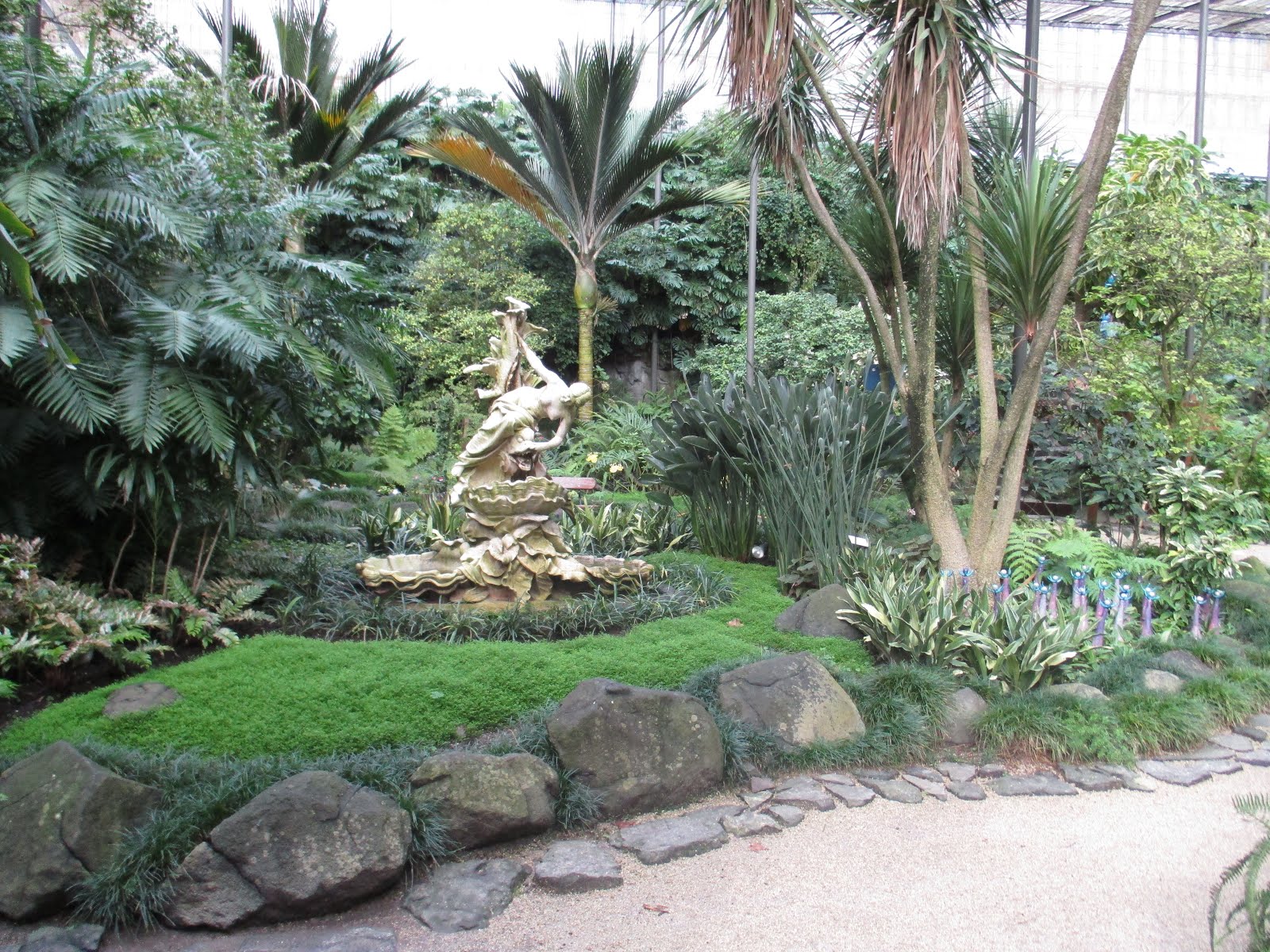
and finally found Estufa Fria, a tiny garden hidden inside the large park. Unfortunately, we were a bit late: Estufa Fria was closing within an hour and was already closed for entrance. It was getting dark, some time to walk around the city still remained but we didn't have any other plans for that part of Lisbon. So we sat down not far from the garden entrance and started scrutinizing the map trying to find the place to spend the rest of the day. Suddenly we heard a strange sound. I was sure that there were no people around that place just a few minutes ago. Actually, there were still no people. That sound belonged not to a human being but to...
Just imagine how surprized we were! A peacock walking in a public park with ease, not frightened of people at all. Have you seen anything like that anywhere else? It was an amazing end of the day!

Tuesday morning we returned to that part of the city. This time the garden doors were opened. Estufa Fria appeared to be a nice cozy place inside, but nothing more than that. My verdict is the following: it's a good point to respite on the way to some other sight but definitely not a must-visit landmark. 
After chilling out in that garden full of exotic plants, we walked towards the next point of our route, Gulbenkian Museum. Instead of familiarizing ourselves with its art collection, we learned that Tuesday was a day off there. Once again, like twenty hours before, we were met by closed doors but this time we haven't the next day to revisit the same place. One more location to keep in mind for the case if I find myself in Lisbon sometime in the future.

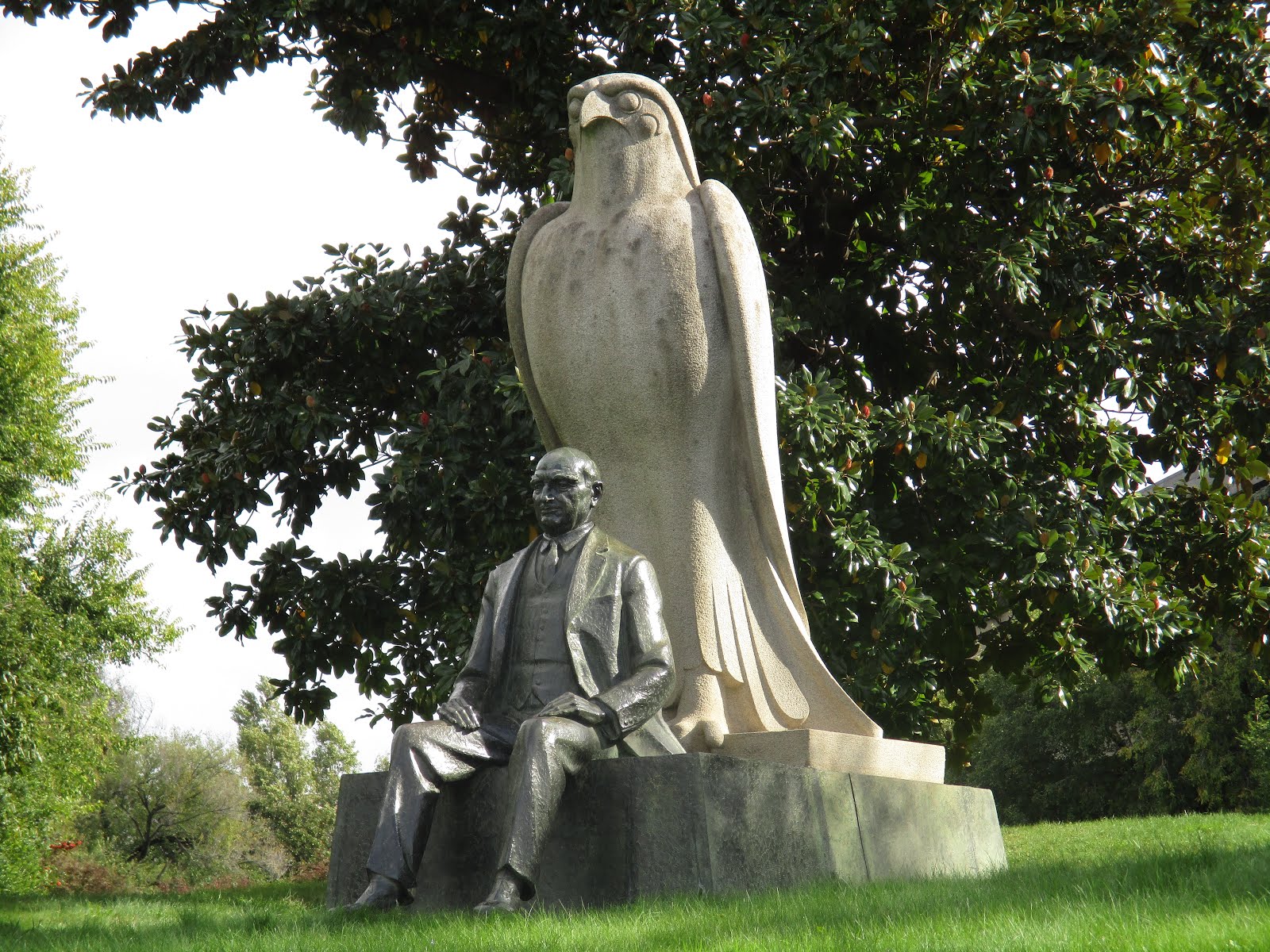
Stopped by a closed door? Look around for a huge bird! (you'll find it, proven twice)
I was unable to find what does this bird stand for. The man in front of it is Calouste Sarkis Gulbenkian, a British businessman and philanthropist of Armenian origin. The museum, which didn't let us in, was founded in conformity with his last will and testament.

Falling to get into some place has a hidden benefit. That way we save time for the remaining plans (and only walk outside a bit more but who will complain about it?). Read about those plans in the oncoming posts. Until next week :)